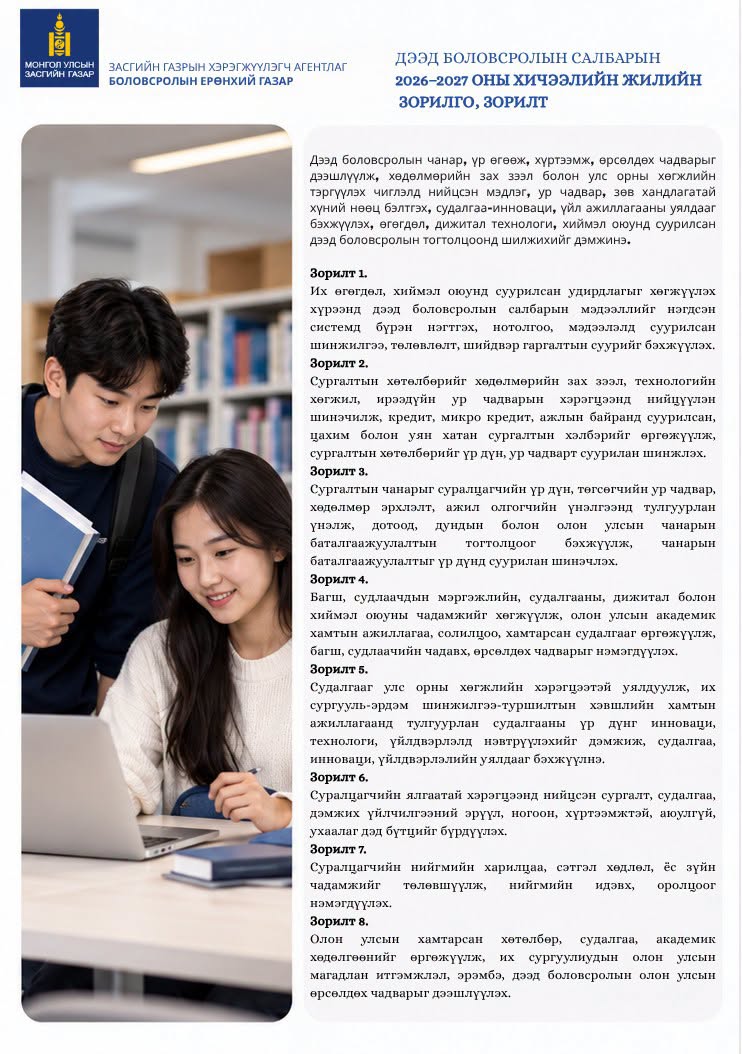
The General Authority for Education, an executive agency of the Government, presented eight strategic objectives to enhance the quality and accessibility of higher education and implement digital and AI-based reforms. The goals for the 2026–2027 academic year have been defined to improve the quality, efficiency, accessibility, and competitiveness of higher education, as well as to prepare human resources with the knowledge, skills, and positive attitudes aligned with labor market demand and national development priorities. Within the framework of these reforms, special emphasis is placed on strengthening the link between research and innovation and transitioning to a higher education system based on data, digital technology, and artificial intelligence.
8 Strategic Objectives of the Higher Education Sector:
Data-Driven Governance: Develop management based on big data and artificial intelligence, fully integrate sector information into a unified system, and strengthen evidence- and analysis-based decision-making.
Curriculum Reform: Update curricula based on results and skills by expanding credit, micro-credit, work-based, and flexible training forms in line with labor market needs and technological development.
Quality Assurance: Evaluate educational quality based on student outcomes, graduate skills, and employability, and strengthen internal and international quality assurance systems.
Capacity Building for Faculty and Researchers: Develop the digital and AI competencies of teachers and researchers, and expand international academic collaboration, exchanges, and joint research.
Research and Innovation: Align research with national development needs, support university-research-industry collaboration, and integrate research outputs into innovation and technology.
Supportive Learning Environment: Build an eco-friendly, green, accessible, smart infrastructure and environment that supports education, research, and services tailored to the diverse needs of learners.
Public Engagement and Ethics: Cultivate social interaction, emotional, and ethical skills among learners, and increase their active social participation.
International Cooperation: Expand joint international programs and academic mobility, improve international accreditation and ranking of universities, and boost overall competitiveness.